This will be the final post for my free inquiry project. It has been a great experience. Normally, when prepping for a campaign, I’m quite disorganized. So it was great to look at some other tools that can make more sense of the chaos of creating an adventure. Obsidian was probably the most helpful of the tools I looked at for my inquiry project. You can check out the fruits of my labor down below.
A message I might give to a future EDCI 336 student as they begin thinking about their inquiry project is to choose something you know, like, and want to improve.
I’ve really enjoyed this project and hope to keep working on it in my own time. So thank you for following along. Forward into adventure!
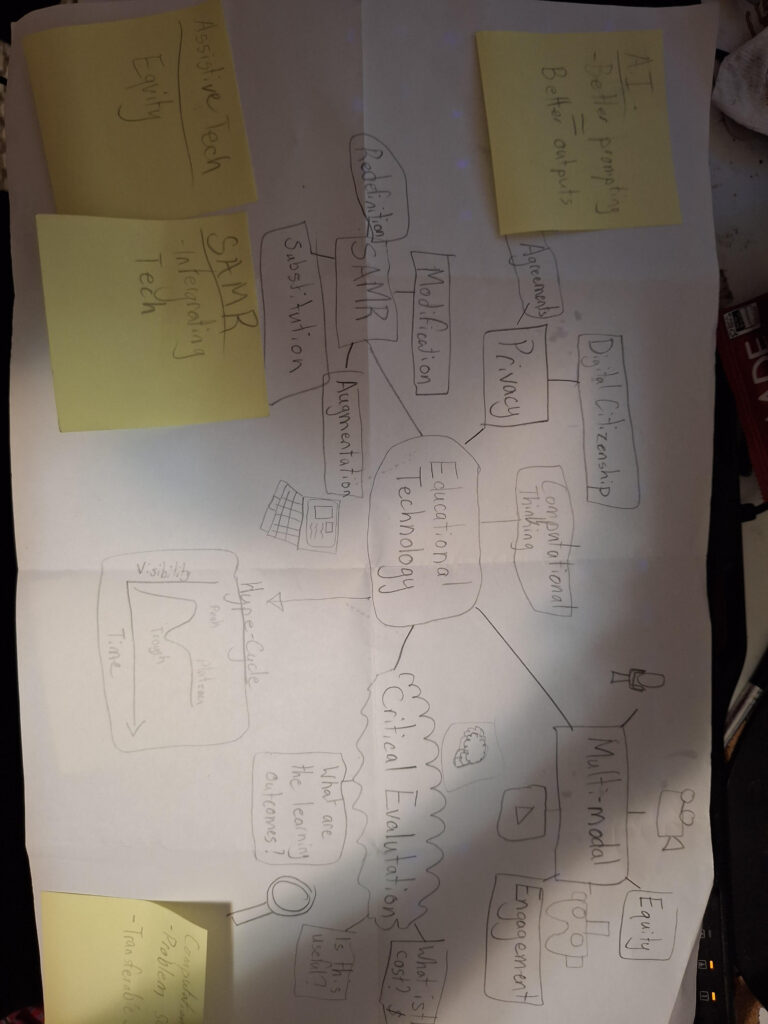
This is the final reflection for EDCI 336. Over the term we examined different topics in educational technology. To reflect on what we learned, we did sketch noting.
Sketch-noting is a way of note-taking that combines doodles and visuals with key ideas. This utilizes dual-coding cognitive learning theory posits information is retained better when presented through both visual and verbal modes.
Here is what I worked on:
This has been a very informative course, and I hope to implement what I learned into my practice as a future educator.
This week we reviewed privacy and digital citizenship, particularly the digital footprint, an ever important topic. Digital citizenship covers the responsible and safe use of technology and how to behave online. A digital footprint is the permanent trail someone leaves on the internet through all their activities.
We looked at different ways the digital footprint can be used by companies like data brokers
Firstly, browser fingerprinting is a method in which companies use meta-data like, battery percentage, timezone and hardware specs, etc., to create a profile that can be used for targeted ads. Next, Data brokers can use information available on social media and other websites to buy and sell data to advertisers. Lastly, lookalike models, which create a “web” of social connections and track what friends and people you spend time with are doing on the internet. From this information, companies produce targeted ads.
While this is slightly disturbing to think about, there are ways we can stop these targeted ads and data brokers. Using ad blockers, adjusting privacy settings and request data releases from data brokers are just a few ways to combat this issue.
In regards to how this applies to education, it is important to think about the activities our students are doing and how they might affect their lives outside of schools. Being able to model good online privacy practices and teach digital citizenship are skills that we must be able to carry into our careers.
So we have our town and its denizens detailed, now we can get to work on plotting the first adventure and planting our adventure seeds we developed from those NPCs.
First Adventure
When developing an adventure there are a couple of ways to do it. The way I have develop in my near 15 year long tenure as a GM is to think of what you’d like the pay-off or the climax to be and work backwards from there. This is called backwards design (very similar to lesson planning used in pedagogy).
For our goal or pay-off, I’d like to resolve that conflict with the sheriff stealing artefacts and Art Driscol’s goal with detecting and dealing with some bandits. We established the forest will have some goblin bandits roaming around causing some problems. So we will make our first adventure focused on that and work our way from there.
Bandits
Our bandits are goblins, small green humanoid creatures with a propensity for mutation. In the past, works of fantasy have some creatures, like goblins, being labelled as ontologically evil. Recently there has been a change to how many creatures are presented. A more nuanced and morally complex approach to portraying these creatures and peoples has occurred. As such these goblins need a motivation for them being bandits that puts them at odds with the farmers of Myra’s Tower
So let’s make a bandit leader before we move on. We’re going to go back to our old friend UNE to make our bandit leader. We rolled “uncouth” and “mystic.” So we have an ill-mannered mystic, why is this guy a bandit? We can use the motivation table to get a starting point- “prepare myths.” This bandit was seeking out some kind of forbidden lore or something.
Let’s roll for a quirk to add some flavor. We rolled pyromaniac. Our goblin has a fascination with fire. Let’s extend that to the whole gang.
For the name, I want something kind of vulgar to reflect their uncouth nature and a reference to their love of fire. Flamebreath sounds good. Their gang will be the Fire Eaters.
Hideout
Every villain or bad guy needs a cool headquarters, right? (not always the case- Hans Gruber from Die Hard was fine just raiding Nakatomi Plaza without an evil lair).
So let’s design our first villains home. I want to push that post apocalyptic ruins aspect of our setting so let’s make an old ruin. Given we are in a more agrarian area, we’re going to make the ruins an old windmill with a cavern underneath.
For the name of this place, I think I’m going for a descriptive name for now. Windmill Cave.
With that we can start to make some encounters.
Encounters
In RPGs any challenge, combat, roleplay or exploration, is called an encounter. These encounters are scaled to the relative power level and competence of their. I won’t bore you with the mechanical minutia of creating a balanced encounter using the Pathfinder Second Edition GM Rules.
Firstly, let’s assume the bandits have a fortified perimeter to their hideout. So one of the encounters we can have is the sentries on the palisade. Goblin bandits are tricky, they might want to project their strength and have some dummies on the wall to trick outsiders into thinking this palisade is an impregnable bastion.
So let’s throw a couple of goblins like three on the walls. That’s one encounter
Maybe they have an outer patrol that goes hunting and warns the main camp about any intruders on their territory. We’ll put two goblin warriors riding on two goblin dogs (these are large rat-like creatures that goblins have an affinity for).
Inside the palisade will be a small camp, this is where the outer patrol and the sentries stay. Let’s have a couple of goblins here that are watching the entrance and some goblins slacking off.
In the windmill, the goblins have made it into a watch tower and a prison, hoisting their hostages in cages rotating on the windmill’s gears. We can have some npcs that were kidnapped in the goblin raid to some stake and a moral reason to chase after the goblins. The jailor will be a bugbear, a tall, hairy, brutish kind of goblin.
Inside the cavern we can have place where they keep their goblin dogs in a kennel and they’ll need someone to look after so that’s another encounter.
I also like the idea of the goblins having some food source beyond stealing. They might farm some rats or mushrooms. This also gives a chance for there to be a non-hostile npc in the caverns.
Next lets make a place for the goblins to relax and eat. We can have a group of goblins drinking and making merry alongside a bard. Bards are not only musicians but can be spellcasters, this will be a good opportunity to introduce the party to some of the spells enemies can throw at them. Since the goblins have been drinking, they will have a status penalty making them a little easier to deal with.
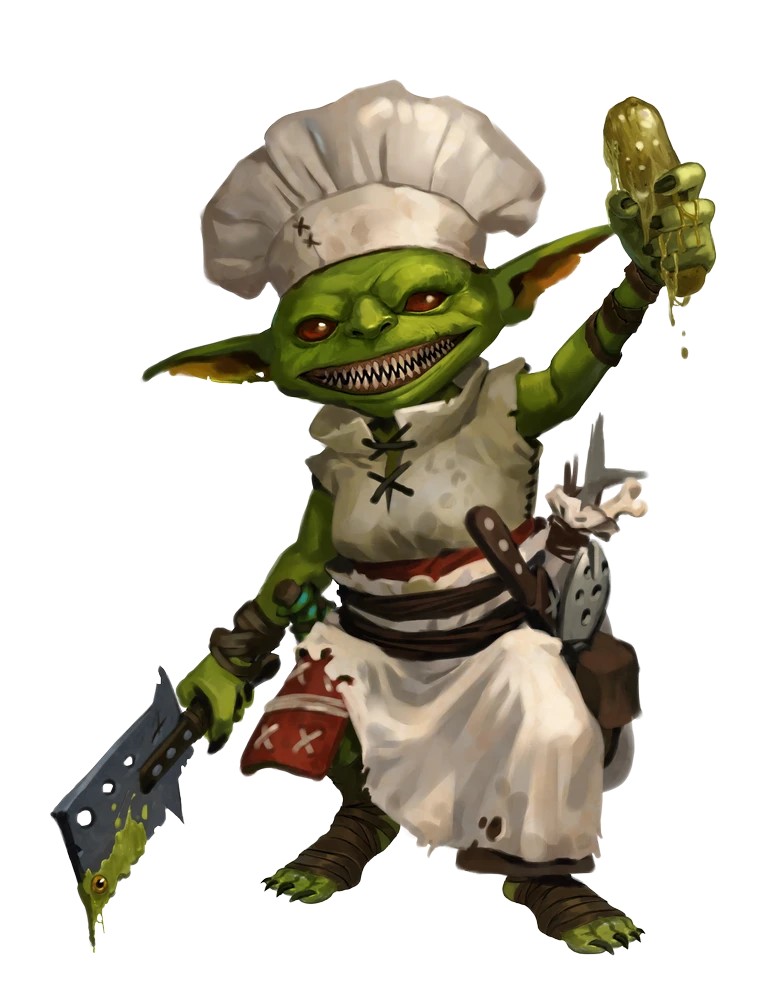
Goblins need to eat so we have a kitchen. The new monster core includes a statline for a goblin chef. I’d like to include one alongside some assistance and maybe a meal that has gotten out of hand.
The goblins dispose of anything they don’t need by feeding it to an ooze, a living acidic jelly creature that lives in one of the cave’s shafts.
We’ll have a barracks or a sleeping quarters where some of the goblins are relaxing. If the party has been quiet in dealing with the other goblins in the cave, they might be able to take these goblins unawares.
Before the boss’s quarters we have a hallway guarded by a pair of his chosen goblin commandos. These guys are a cut above the average warrior and wield long halberds giving them decent reach. I also want to put some pit traps that will trigger if someone heavier than a goblin goes across the false paneling.
Finally we have Flamebreath and his bodyguard. Flamebreath has hired an ogre mercenary, a large gluttonous giant creature. This will be a climatic battle with a magical caster and a meaty tank.
After defeating the goblin bandit boss, the party can take part in the spoils of a treasure room. The Pathfinder Core Rules has a comprehensive guide on how much treasure to give, I generally like to tailor some of the treasure to the player character’s ability (e.i. Give the swordsman a cool magic sword).
Among the treasure will be a note to the sheriff implicating him in the bandit raid. There will also be a magical artefact tied to the local forest spirits. When interacted with the artefact will present the player characters with a vision! The vision will be cryptic and demand that the horn be returned to the cradle lest woe betide the houses in the pinion’s shadow. (Visions are great ways to introduce curveballs).
I’ve been making these notes in obsidian to make a flow chart of how the adventure can proceed and the general beats and encounter info we have. Check out this video to see more!
Making maps is a fun and interesting part of planning, I am going to reach that part later.
Getting the Party there
Very commonly, when a campaign starts the players make their characters and they start in a tavern. They don’t know each other and getting them to interact with each other can be a bit awkward. Then, to move things along, the GM will have one of three things happen: some stranger approach them and offer them a job; they hear a rumor or something that leads to the adventure; or, the classic, a bunch of [insert hostile monster or enemy] burst through the door and start a brawl. There is nothing wrong with campaigns that start this way, but I personally have been in enough campaigns that have started this way.
Player agency is another thing to consider when thinking of the first adventure. Why is the player character deciding to go on dangerous missions. I have been in some campaigns where in the first session a player will say “This is not my problem! I am going to go to the bar and try to meet a cute guy.” Such cases are the result of a mismatch of GM and player expectation. Part of this can be remedied when we know who our players and their characters are.
For the time being we can have the town of Myra’s Tower contact the player characters, asking for their assistance to deal with the growing bandit threat. The player characters arrive at the town and meet the council and are given their quest and directions. IF they want to pursue something else, the bandits might attack again…
Alternatively, we could cut the fat and just start at the adventure location (in media res), or just as they are departing to travel to the location.
Wrapping Up
So we have a skeleton of our first dungeon, Windmill Cave, and the encounters. I have been trying to use obsidian as a way to track encounters. So next time I we’ll map out the encounters in obsidian and make an actual map. We can also start laying the seeds for more adventure for the party to partake.
So we’ve created our town, Myra’s tower. An isolated farming community surrounding an ancient tower. Time to think about some of the personae dramatis that inhabit the town. One particular tool that is great for making up characters and personalities is the Universal NPC Emulator (UNE). UNE has a table that can help generate some ideas for NPCs. With two rolls of a hundred sided die (or 2 ten sided dice, colloquially known as a d100) we can generate a modifier and a noun to get the idea of the general character we are making. This provides a starting point for us to fill in the blanks with the context we create for our characters and can lead us to establish some connections we might not have been thinking about beforehand.
Once we get a basic idea of our NPC we can flesh them out with a desire (short term goal), and an ambition (long term goal). I borrow and adapt these ideas from Game Designer Jason Carl, who described a similar process for making characters in his own game Vampire the Masquerade.
Not all NPCs need goals, it can be exhausting to make ten NPCs with their own goals and backstories and the like. Instead, you can make them extras or players
Things like character appearance and name can be informed by these goals and the general traits. Sometimes I think about if this character was to be portrayed by an actor, which actor would we use. I used to surf the web for fanart and use those for my NPCs, but with the advent of AI art, I abstain from such a practice as I find the art uncanny and weird, (not to mention the ethical quagmire that surrounds such a subject.)
Leadership
We established last time that the town was governed by a council of elders or elected officials, let’s put a name to that. Let’s make the council of officials three, that way we can get two different extremes and a moderate position. This is also a way to incorporate some of that intrigue into the first settlement.
Malakai Red-Axe
For our first councilor, I have rolled pushy polymath (alliterative) on UNE. I want to show that dwarves are in our town so let’s make them a dwarf. So we have a dwarven expert who is pushy with their goals. This dwarf has some expert knowledge regarding smithing and engineering for the saw mill, making them a valuable asset. They could also be a leader for the local dwarves (in fantasy dwarves are often regarded as clan and family oriented). This makes them have quite a lot of leverage in the community and secured them their seat on the council.
Let’s think about what this character wants and what they believe. Luckily UNE has us covered for motivations with a verb and a noun. We got “strengthen” and “resources.” Awesome. Maybe our councilor wants to scale up operations at the saw mill. This might fit into a short term goal for now.
For their long term goal we rolled “attempt” and “old religion.” So, this polymath is researching some old forces to aid them, maybe they want to reconnect with their old ancestors that have been lost. I like this idea, it reminds me of the Hobbit and the dwarves trying to reclaim the Lonely Mountain.
Lastly we need a name and an appearance that reflects their goals and personality. I like the name Malakai, it’s old and sounding. For the dwarven clan names I like to have a colour and an object, or a metal and bodypart or include “hill” or “mountain.” This time, I have decided to use the name Red-Axe.
Malakai Red-Axe is an older dwarf with a greying red beard, a small pair of spectacles with different attachments for his various crafts. He is often puffed up and red in the face from getting into arguments with his fellow councilors
Occia Oak-Arrow
In contrast to our pushy industrious dwarven councilor, let’s make an elven councilor. Elves in fantasy are often seen as more connected to nature, forlorn and sensitive.
Our role on UNE gives us “sensible” and “preacher.” Perfect, let’s make this councilor a local shaman or druid that preaches harmony between the villagers and nature. This puts them in opposition with the Malakai who want to expand further into the woods at the cost of nature.
For their short term goal, we roll have “operate” and “spirits,” perhaps there is something in the woods that they wish to commune with. A druid would have some kind of connection with the spirit world. This is a great seed for an adventure.
For their long term goal we have “undermine” and “allies.” I interpret this to mean that our councilor is trying to sabotage the expansion of the town. Maybe it’s to stop Malakai’s incursion into the forests. We got a kind of plot brewing here.
For elf names I usually use names with soft sounds and vowels and references to woods and nature. I decided the name Occia Oak-Arrow sounded suitable for our druid.
I imagine Occia Oak-Arrow to be an elven female with brown hair with a headband made of brambles. Elves in fantasy often have a timeless and ageless appearance, appearing to never age well into multiple centuries of their long lifetimes. They wear a green robe with some embroidered trees and floral motifs. As a symbol of their position as a druid, they carry a staff of oak topped with some rare herbs. They are never seen without their shortbow made of magical wood in elven craft.
Art Driscol
So we have two extremes of industry against nature (Malakai) and harmony with nature (Occia), we should make someone in the middle of the conflict. Let’s make our human councilor.
Humans in fantasy settings are often bland or “the adaptable and varied” people. I often disagree with this as other people should be seen as adaptable, but tropes and decades of fantasy have cemented some aspects of their identity as “humans but…” I think the thing that defines humans should be their lifespan in comparison to the multi-centuries of elves and dwarves and other people of fantasy settings. However, that is a conversation for another day.
For our adjective and noun from the UNE, we have “optimistic” and “villager.” Let’s make this councilor a representative of the farming aspects of the community. Perhaps they are the largest farm owners of the town. And, as a human, they are maybe newer to the position after the last councilor passed away.
For their desire, we have “detect” and “criminals.” There is a gang of bandits in the woods and our councilor wants them found.
For their ambition, we got “attend” and “moderation.” This councilor is supposed to be a balancing force on the town council between Occia and Malakai; they are actively seeking a resolution between the two.
Another handy way to generate names is to look up names specific to ethnicities or cultural backgrounds. I use Fantasy Name Generators to help make names if I’m stuck.
I imagine Art being played by a Walton Goggins type, he brings a sort of folksy charm to most of his roles that I think would suit Art. I also like Walton Goggins as an actor.
Law and Order
So how does the town of Myra’s Tower keep safe while isolated in a dangerous forest. Given the tight knit nature of the small town, I imagine there is a high level of trust making the need for a large standing police force largely unnecessary. The people of the town have some arms to fight off any attacks on the town.
To deal with internal issues, let’s have a sheriff and a deputy.
Sheriff Underfoot
For our major characters in the town, we have had a dwarf, an elf and a human. The next major people we can represent are halflings (or hobbits, but legally distinct because of legal issues from the Tolkien estate against Dungeons and Dragons in the 1970s).
We head to UNE and get “lazy” for the adjective, we already know the noun more or less so we’ll not roll on the noun table. A lazy sheriff, maybe not much happens in the town so the Sheriff takes to sleeping on their porch and having extended lunches at the tavern.
What does this sheriff want?
UNE gives us “secure” and “alcohol” of their goal. Our sheriff just wants to get to their next pint and not bother with the goingson at the town. (I’ll need to be careful how I play this as I wouldn’t want to make light of a drinking problem or bring in something that hits too close to home for the players. This kind of issue will be revisited when we look at safety tools for roleplaying later in the campaign prep.)
For the sheriff’s long term goal we have “rob” and “spirits.” We could double down on the alcohol theme, but given we have established that Occia is trying to commune with the forest spirits, maybe our sheriff wants to steal from them.
For the name, I look to the Lord of the Rings and the Shire for the names of our hobbit friends. They have names like “Underhill, Proudfeet, Brandybruck, Took” folksy names that seem lighthearted and descriptive. Let’s smash two of these names together and see what we get. Underfoot.
Sheriff Underfoot is a middle aged halfling with thinning blond hair and a great pair of mutton chops. He has a bulbous red nose and chubby, rosy cheeks. His rotund belly is often kept in check by his breastplate embossed with the symbol of his office.
Deputy Kara Kathil
Aiding the lazy sheriff is his faithful deputy, let’s see what we get with UNE, there are a number of ways this could go.
We get “insightful” and “ranger.” This is in opposition to our lazy sheriff. This deputy works out in the forest and is inquisitive in their investigations and dealings with the law.
For their short term goal we get, “comprehend” and “animals.” This ranger is trying to understand something about the wildlife nearby. Another hook for the list.
For their long term goal we have “overthrow” and “laziness.” Our deputy does not like our Sheriff and will have ambitions to succeed him. On the list this goes.
I decide to make this person an aivureen or a half-elf, a person with some elven parentage that gives them some aspects of the graceful, long lived magical elves. This is kind of a staple of woodland warriors like Aragorn from Lord of the Ring who has that connection to the Elves of Rivendell and the ancient heritage of Numenor that gives him enhanced abilities compared to the “standard” human.
For the name I like the name Kara and alliteration is alway fun so another “K” name with some soft sounding “elf sounds” would be great. I decided on “Kathil.”
Deputy Kara Kathil is a half-elf that spends most of their time patrolling, giving them a rugged and survivalist appearance. They often wear their hide armor decorated with the teeth and claws of dangerous animals. Even in town they wear a camouflage cloak and hood, which obscures their features. Most people in town haven’t seen Kara’s face, leading to rumors about their true appearance and their past. They are never without their elven branch spear, a family heirloom used to fell beasts.
Religion and Faith
Previously we discussed that the major faiths of Myra’s Tower would be Erastil, god of farming and nature, dwarven god Torag and the elven god Ketephys.
Gunter, Cleric of Erastil
Erastil worship in Myra’s Tower is by far the most popular among the villagers. Erastil’s worship focuses more on deeds and reverence as opposed to ritual so we don’t need an elaborate church, instead we will have a small shrine in the village square where people might make offerings. Much like the places of worship, the clerics are more simple and “leading by example and serving in various capacities as needed by those that live around them. This can include helping in childbirth, building structures, overseeing fair trade, and blessing crops.(Mona et al, 2008)”
Our priest of Erastil will be an old farmer and hunter. They do their best to help those living in harmony with nature in accordance with the example set by Erastil. Their goal will be to better the town without harming nature.
For the name we have a simple name like Gunter, suitable for a medieval style setting.
They wear a fur cloak and robe with a symbol of Erastil on their neck. Their long wide beard hides the wrinkles on their face, earned from a lifetime of toil in the fields and forest.
Aaron Bright-Hammer, War-Preist of Torag
Torag is the head of the dwarven pantheon and is mostly followed by dwarves, however other peoples might worship him and his domains of protection, craftsmanship and wisdom. Since most of the dwarves are associated with the Red-Axe clan we can have a small chapel on the Red-Axe clan’s estate.
For the priest we rolled “pleasant” and “warrior.” Our priest of Torag is not only a priest but a war priest. In fantasy, especially devoted members of a faith may take up arms to protect their fellow adherents and further their god’s agenda.
For their goal we rolled, “uplift” and “the oppressed.” We have recorded that the dwarven clan here might have lost something from their ancestors. I’m going to borrow a leaf from Middle Earth and have the Red-Axe clan be refugees from their home, lost ages ago. Our War-priest seeks to uplift and galvanize these dwarves into finding a new home or reclaiming their old home.
We could make this priest part of the Red-Axe clan, but maybe they just find a particular alignment with them because of their adherence to the faith. For the name we’ll take a step away from the Red-Axe clan and make a different dwarven name. I decide on Aaron Bright-Hammer.
Aaron Bright-Hammer, war-priest of Torag is a kind and friendly individual. This demeanor is betrayed by the armored robes he wears and the large hammer emblazoned with symbols of his dwarven god he carries on his back.
Occia Oak-Arrow, Druid of Ketephys
For the worshipers of Ketephys, I think Occia fits best for being a priest of this faith. Occia might maintain a small shrine on the border of town. Maybe a lonely tree on a hillside overlooking the farms and the forest.
Services
A town serves a function in a RPG campaign as a place to get quests, rest, roleplay and do some much needed shopping. As such, the shopkeeps and other services providers in town will be one of the party’s most interacted with NPCs.
There are many services that a town would need to operate, but for our purposes I general focus on the things the party will need: weapons and armor (blacksmith); medicine and potions (healer); adventuring supplies (general store); mounts and animals for traveling (stable); and a place to eat and stay (inn).
Blacksmith- Benjamin Red-Axe
We have established that a clan of dwarves live in the town and that Malakai is their. So let’s make another dwarf to fit into the role of the village blacksmith.
UNE gives us the adjective “jovial” for our blacksmith. So in contrast to their relative Malakai, this person is in good spirits and friendly.
Since this NPC is a bit player, not a major focus, I’m going to give them one goal. If they become a more major player through the game, we can revisit and give them another goal.
UNE gave us “collaborate” and “the wealthy,” so our blacksmith works for the wealthy of the town. This makes sense, Malakai would have need for saw blades and metal parts for the mill and Art would need tools and the like for the farms
Great, as for a name lets look at something in the same name as Malakai. Malakai is a hebrew name so let’s grab one of those. A quick google search gives us Benjamin. Great we have Benjamin Red-Axe, the jovial dwarven smith.
Benjamin Red-Axe is a male dwarven smith. He always has a smile peaking out from his large red bread decorated with rings and baubles of different metals.
Healer- Old Lady Ulga
Medicine and healing is an interesting area a fantasy and depends on the level of magic we want to include in the setting. A high magic setting might have disease and injury be trivial matters if healers can perform the right healing spell, whereas a lower setting might reflect medical practices of medieval times of our own world. I like a sort of in between where communities rely on folk remedies and non-magical physicians and magical healers are prized and coveted for their skills.
Our healer will be some kind of wise or cunning folk, someone skilled in herbalism and folk remedies.
For this person’s general personality, we aren’t going to use UNE, we can use a common trope to make a sort of grandmotherly hermit figure that lives on the edge of town. They might be a bit eccentric, but their skills make them a valuable asset to the town and the townsfolk swear by her advice.
For their goal, I got “promote” and “love.” Our healer also wants to play match maker. To the list of adventure prompts.
For the name, I’ve been reading about Baba Yaga, an slavic folk tale character that is often depicted as an elderly magical old woman. So let’s give this elderly magical old woman an eastern european name like Ulga.
Old Lady Ulga is a hermit that lives on the edge of town rarely interacting with the townsfolk except to tend to their injuries or sicknesses. Despite her isolation from the town, Ulga is often cheerful and doting towards those that approach her hut. She wears a green headscarf and sheepskin shawl over blue robes. A belt of potion vials, herbs and animal bits is attached to her waist.
General Store- Alexander
For our general store, we can go any direction we like. We rolled “cultured” on UNE for our adjective. The shop has some fine tastes for the small town.
For their goal, we have “institute” and “academia.” Our cultured general store clerk wants to educate the town. When they are not tending the general story, maybe they act as a teacher for the town’s youth or a scribe for town meetings and the like.
Names for our cultured shopkeep, let’s look at some regal sounding names, I like the name Alexander. As for their ancestry or what kind of person they are, let’s just default to a human.
Richly dressed in fine fabrics and well groomed in styles more seen in the city, Alexander maintains a stock of goods made outside Myra’s tower.
Stable- Ava Grey-Mane
The stable and livery would be an important palace for a pre-industrial society relying mostly on human and animal power. This is also a place where we can get some horses for our party.
For our personality we got Banal and adept. This person is relatively boring. Not every shop keeper has to have a fleshed out personality. This stablemaster is focused on their craft, they’re damn good at raising horses and beast of burden.
For the name I gave them a pretty normal name and a family name that relates to horses.
Ava Grey-Mane is a middle aged human and stable master. She has a small scar running down their nose, a reminder from an accident with a bucking horse. Her family has been breeding and raising horses in Myra’s Tower since the village’s founding.
Inn- Bertha’s Wheat and Chaff
Bar none the most popular place for an adventuring party to visit is the village inn, tavern, bar, etc. It also is a place where the party can rest, eat, drink and relax.
I’d like to think that this inn also serves as a major social hub and the barkeep would be like an unofficial town leader or at least hold quite a lot of sway. They would know everyone and hear rumors about town and news of the outside world from what few travelers stop by Myra’s Tower. The bar keep will be a good information broker for our party when this starts.
In the old days before widespread literacy, taverns and brewhouses would advertise their business with brightly colored and evocative signs and pictures that their mostly illiterate customer base would understand. This tradition continues in fantasy with the naming conventions of taverns and the like. I like to put in oxymorons like the “Quiet Cockerel” or “the Beggar’s Trove.” Alternatively, I look up real British pubs and transplant the name for my own needs. To reflect the farming aspects of the village we will make the villages name something to do with farming. I chose “Wheat and Chaff.”
Bertha is a middle aged human that runs the local tavern and inn with her family. Three generations of her family work in to run the tavern, with her and her husband keeping the bar and kitchen, her sons managing the brewing of ale and her grandchildren serving and cleaning around the place. Bertha treats the whole town as part of her family, though has a habit of overstepping boundaries and being too nosy.
Recording
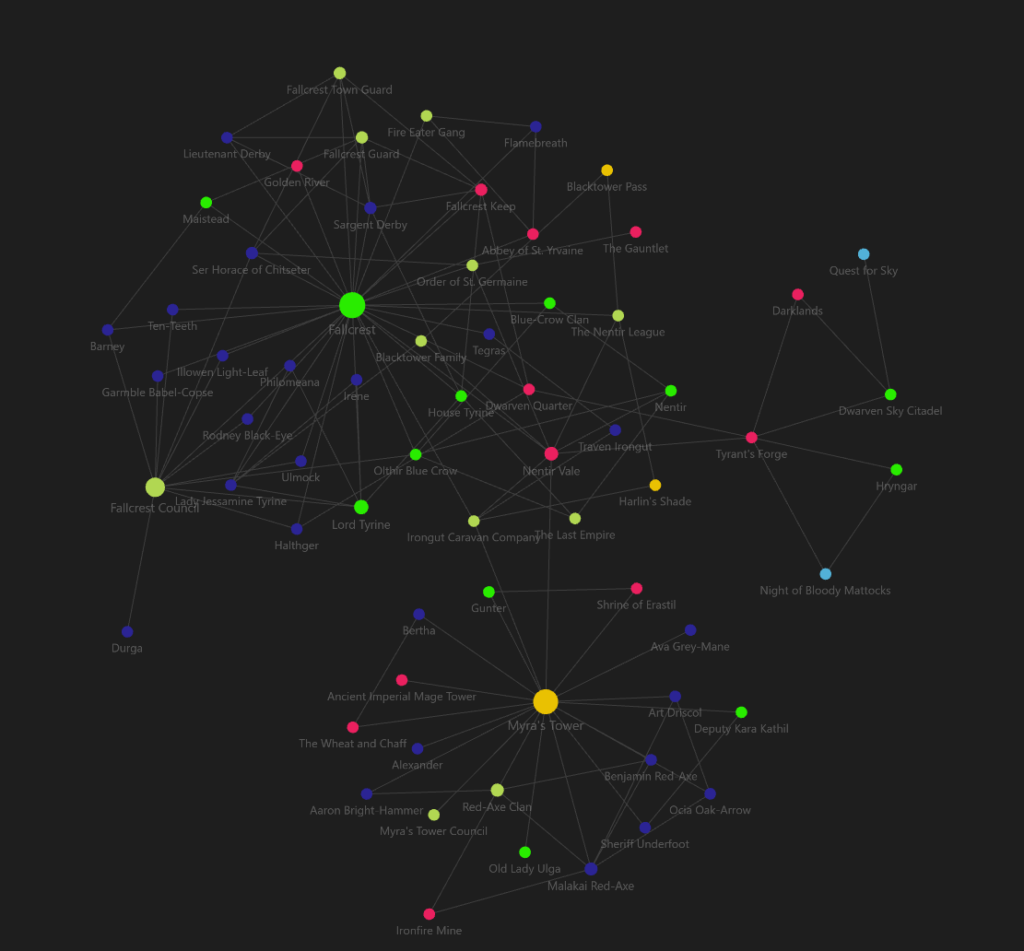
As we make out notes, we’ll need a place to put all our notes. I recently was put onto a program called obsidian, which organizes notes into nodes with strings and pathways showing connections. I’ll input a node for Myra’s Tower and connect all the NPCs to the node. When I need to look up one of our NPCs I can quickly look and see which connections and relationships they have to places, objects, events in the setting and more. This is a game changer from the old notebooks and word docs I used to keep. Here is a screencast from what I have currently- (I have collated Myra’s Tower with another area of a previous campaign hence the extra nodes.)
Wrapping Up
So we have fleshed out Myra’s tower. The next step will be to organize our adventure hooks and get to work on laying foundations for the first adventure of our campaign.
This week we investigated computational thinking and gaming in education.
Computational Thinking
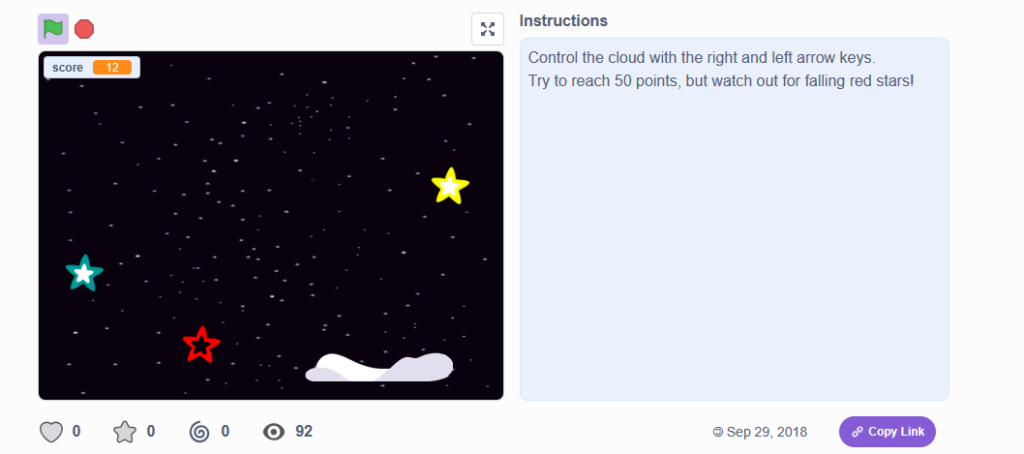
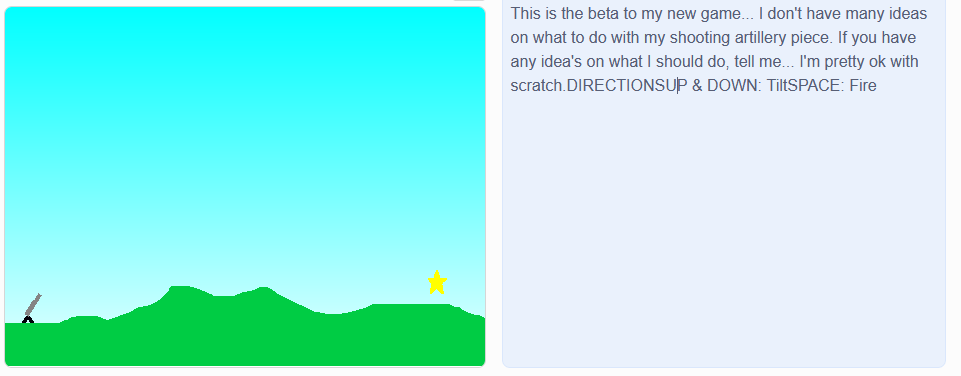
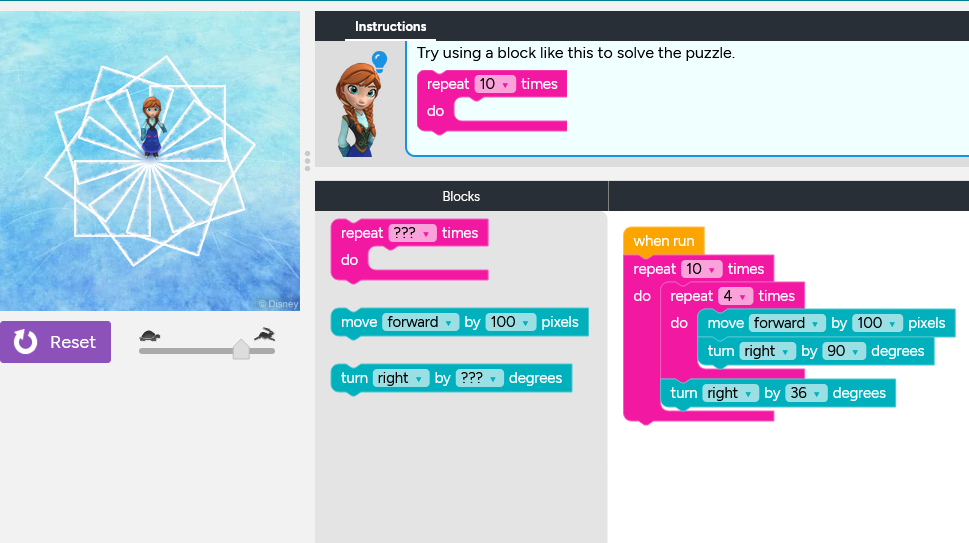
As part of this class we played some games using the Scratch software. These games ranged from Star Catcher, Artillery and Anna and Elsa Ice Skating. Of all these games I found Anna and Elsa the most engaging. The game uses block coding as a mechanic to guide Anna or Elsa along a path.
This game is great for teaching coding but much more applicable skills of computational thinking. This way of thinking focuses on breaking down a problem (decomposition), looking for similarities to other problems (patterns), identifying key information (abstraction) and creating a step-by-step(algorithm).
I teach social studies and this way of thinking can be useful for examining sources, deducing trends in a past era and creating arguments. Like any skill, these require practice and low-stakes games like these can help teach these skills in an computational, fun way.
Star CatcherArtilleryArtillery
Games in Education
Games in education allow teachers and students to engage with material in novel and non-traditional ways. Students would gain an appreciation and possibly make connections that they might not otherwise do in a stand and deliver lecture-centric class.
One example of how one might include games in Social Studies might be roleplaying games like Secret Hitler, which emulates Weimar Germany and how fascism might take control of a nation in secret ways.
An important concern to note is that of time, as there might not. Another is how learning objectives will be accomplished by playing the game. Not every subject or topic might allow for a game. Some topics might be seen as trivialized by gamifying them, as such the teacher should use their best discretion when designing activities and games.
For my groups educational technology presentation, we examined Slido and if would be an effective tool for educators.
Slido is a program that can make meetings more interactive. With Q&A, polls and feedback, teachers can use these as another tool to help students in their learning through formative assessment.
This week we examined the SAMR model for examining the role of technology in the classroom and evaluating activities with technology in mind. We also examined strategies for how how technology can be used to make the classroom more inclusive and accessible.
By Jack Halse
SAMR
SAMR stands for substitution, augmentation, modification and redefinition. It is a framework for evaluating technology intergration in school activities.
The first two steps: substitution and augmentation, are enhancements to existing activities while leaving the bulk of tasks the same. An example of substitution would be writing a story on a computer as opposed to pen and paper. While an example of augmentation would be allowing the use of spell check and other digital tools while writing a story. These two steps do not engage higher order thinking.
The modification and redefinition steps of SAMR allow for more drastic transformation of the task and how technology is implemented in the task. The video gave the example of using an open doc format to allow students to share and collaborate with each other. Lastly, redefinition might allow students to engage in a multimedia way of story telling.
The SAMR approach is a great tool for teachers to have as they explore new avenues for engagement. SAMR can lead to activities where students can engage with material in creative and novel ways. That being said some possible drawbacks might be the lack of access to technologies depending on certain contexts. Furthermore, certain core competencies in the BC curriculum might not allow for deviation from certain product goals.
Accessibility
Why do you think many digital accessibility practices aren’t more well-known or commonly used?
I think that many of the digital accessibility practices are not often thought of when people are designing websites and apps due to the privilege of many of the designers. Many designers might not be thinking about accessibility as they themselves do not have any accessibility issues. That being said, this is changing and there are many extensions and the like that can be used for accessibility such as speechify and other text-to-speech programs.
Are there any digital accessibility practices that surprised you? Why?
I was surprised that headings and captions are considered accessibility practices. I suppose I always expect things to be formatted with the proper use of headings that I haven’t seen them used incorrectly. If headings are not used and formatting is done incorrectly, then information is very hard to absorb and read. Going forward I should be mindful of how my own digital resources are formatted so as to make things more accessible.
This week I attended a Pro-D seminar about building AI literacy in students. AI literacy is a skill of recognizing the strengths and limitations of AI, when it is best to use it and the impacts such a tool can have.
Outright prohibition of AI will not work and will deny students the use of a tool that will continue to play a large part in our lives. However, Students cannot fully trust AI to do the tasks flawlessly and foisting learning onto the AI will rob students of the opportunity to develop important life skills. So, it falls on teachers to help foster a healthy understanding and relationship with AI. Not every project requires AI and different assignments will require a different use of AI.
AI literacy is a swelling branch of pedagogy. In addition to the seminar I attended, there are a multitude of workshops being offered. One such is by New York University’s Professor Amal Shehata.
This is such a crucial moment to learn these skills as AI is rapidly evolving and it is difficult for students and teachers to keep up with the rate of change. Boundaries and expectations for pedagogy must be placed now before AI and irresponsible use of it gets away from us.
This week we looked at some digital resources that we could use in the classroom like Google Classroom. These resources allow for students and instructors to share their work and materials in a seamless way. It also centralizes many of the different responsibilities and roles of the teacher into one program, so a student roster, gradebook, course material, etc. are handled by one program.
One piece of tech we examined was obsidian.md, a note taking and graphic organizer program. Notes are organized into nodes that connect to related notes in a web or lattice. I have been using obsidian for my personal use during my rpg campaigns. Currently I am using the program in my free inquiry project for this class. Here is a screen-shot of my current web for my campaign setting.
I try to organize things by location with major characters that reside in those locations. Currently, I am having an issue with my nodes conforming to the colour tags.
I could see this be an interesting way of organizing notes for historical events in a social studies class, but I would have to be more comfortable organizing and compiling my notes into a more concise, logical manner.
One issue with using these in education is that not all students will have the same level of access to technology outside of school, and even some schools might have limited access to technology. So it is important to keep equity and equality in mind when designing courses and the ways information is shared.
Another issue is accessibility. Many of these programs are designed. However, that can also provide a challenge for those who might have input or output issues or other exceptionalities that can hinder organizational skills. As such it is important to take a temperature check of the class and experiment with which of these kinds of tools work for the class and particular students, and be willing to change and adapt.