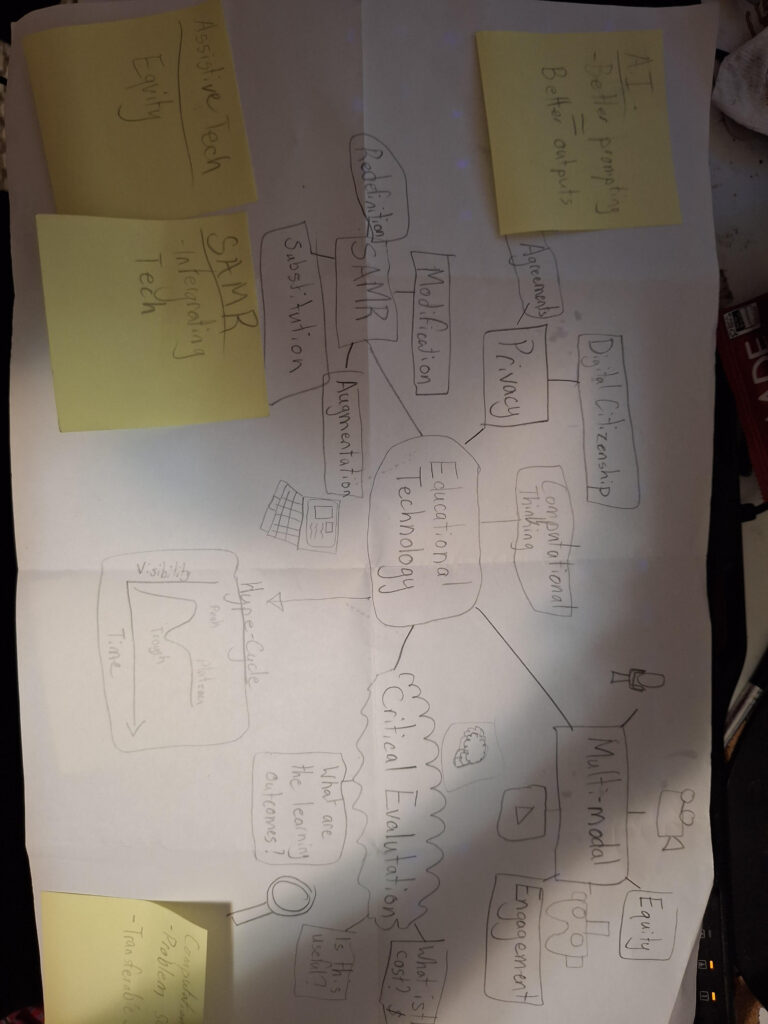
This is the final reflection for EDCI 336. Over the term we examined different topics in educational technology. To reflect on what we learned, we did sketch noting.
Sketch-noting is a way of note-taking that combines doodles and visuals with key ideas. This utilizes dual-coding cognitive learning theory posits information is retained better when presented through both visual and verbal modes.
Here is what I worked on:
This has been a very informative course, and I hope to implement what I learned into my practice as a future educator.
This week we reviewed privacy and digital citizenship, particularly the digital footprint, an ever important topic. Digital citizenship covers the responsible and safe use of technology and how to behave online. A digital footprint is the permanent trail someone leaves on the internet through all their activities.
We looked at different ways the digital footprint can be used by companies like data brokers
Firstly, browser fingerprinting is a method in which companies use meta-data like, battery percentage, timezone and hardware specs, etc., to create a profile that can be used for targeted ads. Next, Data brokers can use information available on social media and other websites to buy and sell data to advertisers. Lastly, lookalike models, which create a “web” of social connections and track what friends and people you spend time with are doing on the internet. From this information, companies produce targeted ads.
While this is slightly disturbing to think about, there are ways we can stop these targeted ads and data brokers. Using ad blockers, adjusting privacy settings and request data releases from data brokers are just a few ways to combat this issue.
In regards to how this applies to education, it is important to think about the activities our students are doing and how they might affect their lives outside of schools. Being able to model good online privacy practices and teach digital citizenship are skills that we must be able to carry into our careers.
This week we investigated computational thinking and gaming in education.
Computational Thinking
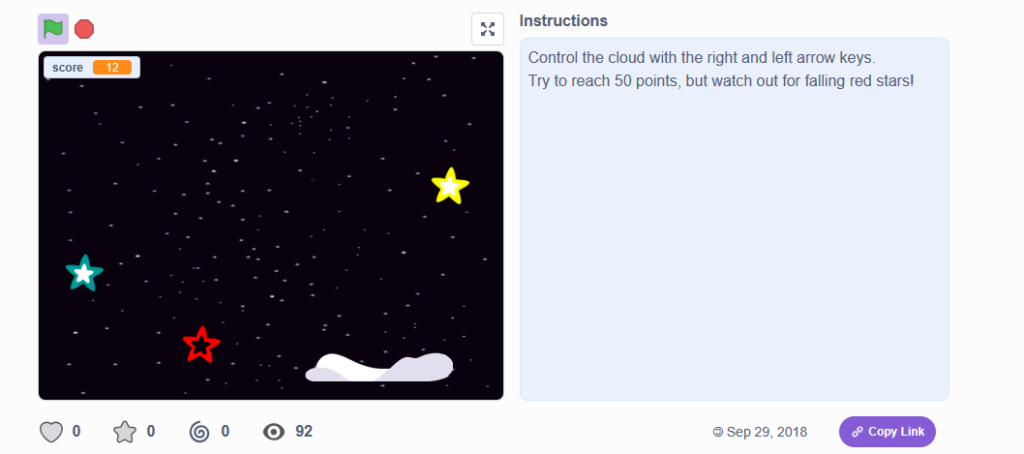
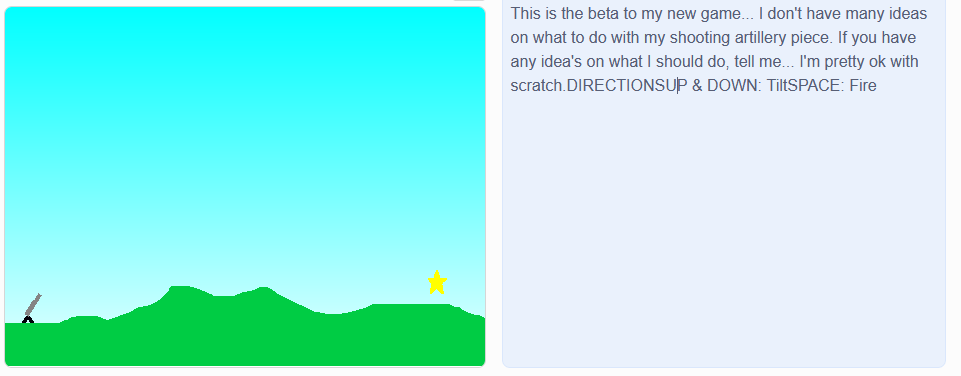
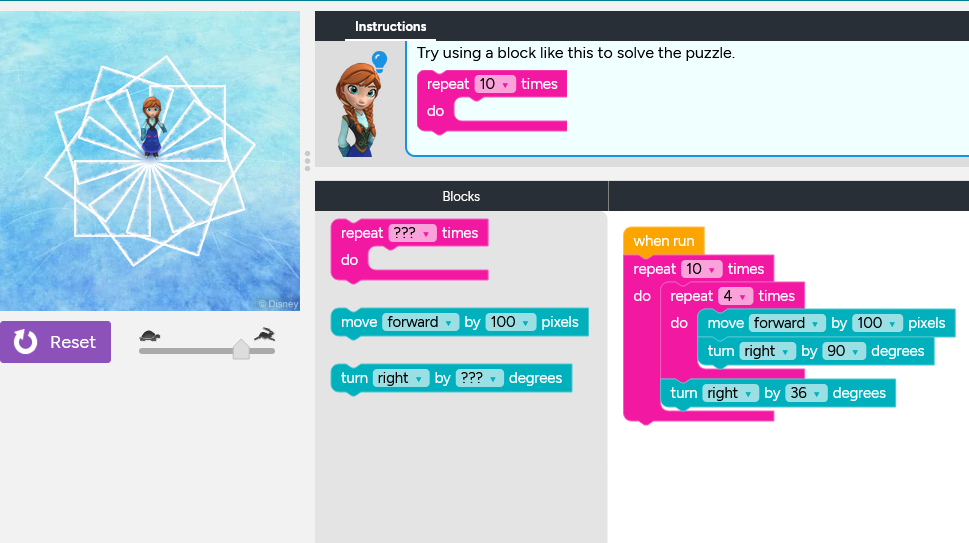
As part of this class we played some games using the Scratch software. These games ranged from Star Catcher, Artillery and Anna and Elsa Ice Skating. Of all these games I found Anna and Elsa the most engaging. The game uses block coding as a mechanic to guide Anna or Elsa along a path.
This game is great for teaching coding but much more applicable skills of computational thinking. This way of thinking focuses on breaking down a problem (decomposition), looking for similarities to other problems (patterns), identifying key information (abstraction) and creating a step-by-step(algorithm).
I teach social studies and this way of thinking can be useful for examining sources, deducing trends in a past era and creating arguments. Like any skill, these require practice and low-stakes games like these can help teach these skills in an computational, fun way.
Star CatcherArtilleryArtillery
Games in Education
Games in education allow teachers and students to engage with material in novel and non-traditional ways. Students would gain an appreciation and possibly make connections that they might not otherwise do in a stand and deliver lecture-centric class.
One example of how one might include games in Social Studies might be roleplaying games like Secret Hitler, which emulates Weimar Germany and how fascism might take control of a nation in secret ways.
An important concern to note is that of time, as there might not. Another is how learning objectives will be accomplished by playing the game. Not every subject or topic might allow for a game. Some topics might be seen as trivialized by gamifying them, as such the teacher should use their best discretion when designing activities and games.
This week we examined the SAMR model for examining the role of technology in the classroom and evaluating activities with technology in mind. We also examined strategies for how how technology can be used to make the classroom more inclusive and accessible.
By Jack Halse
SAMR
SAMR stands for substitution, augmentation, modification and redefinition. It is a framework for evaluating technology intergration in school activities.
The first two steps: substitution and augmentation, are enhancements to existing activities while leaving the bulk of tasks the same. An example of substitution would be writing a story on a computer as opposed to pen and paper. While an example of augmentation would be allowing the use of spell check and other digital tools while writing a story. These two steps do not engage higher order thinking.
The modification and redefinition steps of SAMR allow for more drastic transformation of the task and how technology is implemented in the task. The video gave the example of using an open doc format to allow students to share and collaborate with each other. Lastly, redefinition might allow students to engage in a multimedia way of story telling.
The SAMR approach is a great tool for teachers to have as they explore new avenues for engagement. SAMR can lead to activities where students can engage with material in creative and novel ways. That being said some possible drawbacks might be the lack of access to technologies depending on certain contexts. Furthermore, certain core competencies in the BC curriculum might not allow for deviation from certain product goals.
Accessibility
Why do you think many digital accessibility practices aren’t more well-known or commonly used?
I think that many of the digital accessibility practices are not often thought of when people are designing websites and apps due to the privilege of many of the designers. Many designers might not be thinking about accessibility as they themselves do not have any accessibility issues. That being said, this is changing and there are many extensions and the like that can be used for accessibility such as speechify and other text-to-speech programs.
Are there any digital accessibility practices that surprised you? Why?
I was surprised that headings and captions are considered accessibility practices. I suppose I always expect things to be formatted with the proper use of headings that I haven’t seen them used incorrectly. If headings are not used and formatting is done incorrectly, then information is very hard to absorb and read. Going forward I should be mindful of how my own digital resources are formatted so as to make things more accessible.
This week I attended a Pro-D seminar about building AI literacy in students. AI literacy is a skill of recognizing the strengths and limitations of AI, when it is best to use it and the impacts such a tool can have.
Outright prohibition of AI will not work and will deny students the use of a tool that will continue to play a large part in our lives. However, Students cannot fully trust AI to do the tasks flawlessly and foisting learning onto the AI will rob students of the opportunity to develop important life skills. So, it falls on teachers to help foster a healthy understanding and relationship with AI. Not every project requires AI and different assignments will require a different use of AI.
AI literacy is a swelling branch of pedagogy. In addition to the seminar I attended, there are a multitude of workshops being offered. One such is by New York University’s Professor Amal Shehata.
This is such a crucial moment to learn these skills as AI is rapidly evolving and it is difficult for students and teachers to keep up with the rate of change. Boundaries and expectations for pedagogy must be placed now before AI and irresponsible use of it gets away from us.
This week we looked at some digital resources that we could use in the classroom like Google Classroom. These resources allow for students and instructors to share their work and materials in a seamless way. It also centralizes many of the different responsibilities and roles of the teacher into one program, so a student roster, gradebook, course material, etc. are handled by one program.
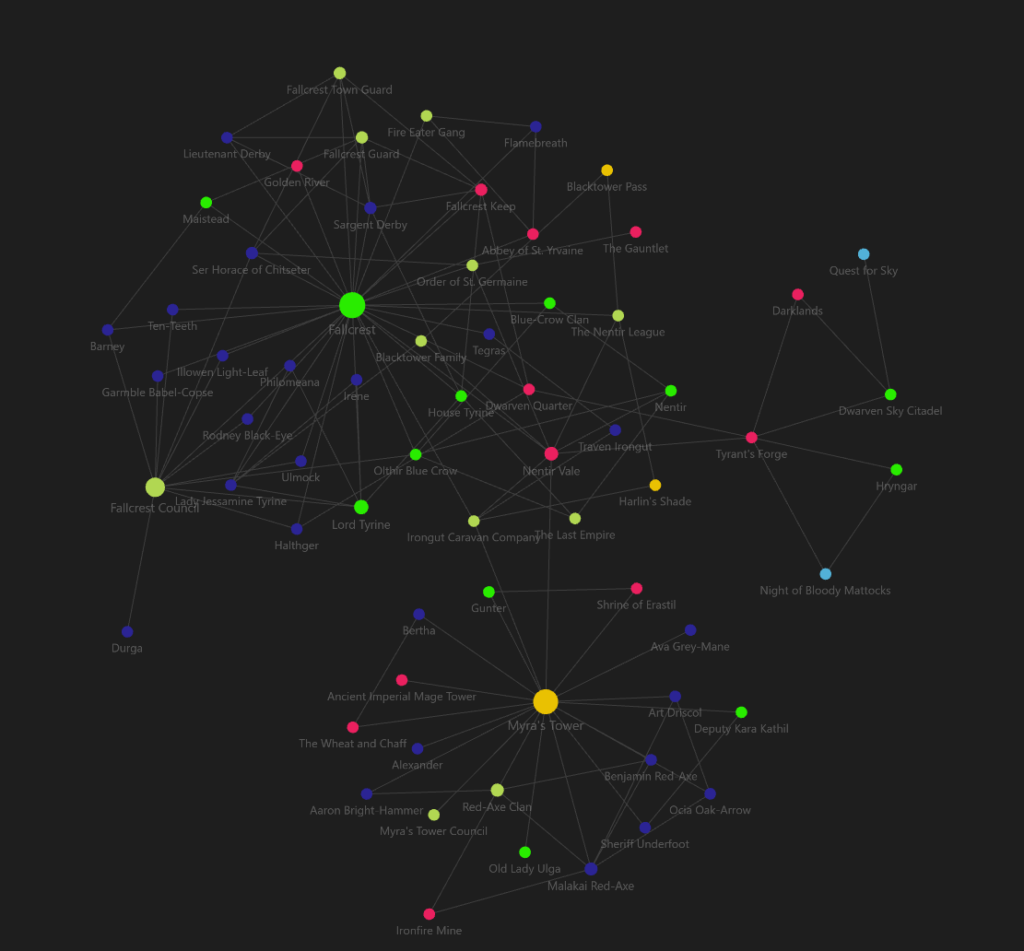
One piece of tech we examined was obsidian.md, a note taking and graphic organizer program. Notes are organized into nodes that connect to related notes in a web or lattice. I have been using obsidian for my personal use during my rpg campaigns. Currently I am using the program in my free inquiry project for this class. Here is a screen-shot of my current web for my campaign setting.
I try to organize things by location with major characters that reside in those locations. Currently, I am having an issue with my nodes conforming to the colour tags.
I could see this be an interesting way of organizing notes for historical events in a social studies class, but I would have to be more comfortable organizing and compiling my notes into a more concise, logical manner.
One issue with using these in education is that not all students will have the same level of access to technology outside of school, and even some schools might have limited access to technology. So it is important to keep equity and equality in mind when designing courses and the ways information is shared.
Another issue is accessibility. Many of these programs are designed. However, that can also provide a challenge for those who might have input or output issues or other exceptionalities that can hinder organizational skills. As such it is important to take a temperature check of the class and experiment with which of these kinds of tools work for the class and particular students, and be willing to change and adapt.
This week, we discussed some of the advantages and disadvantages of Generative Artificial Intelligence (GenAI) and how it might be best applied in education. In my personal opinion, GenAI is a fad for education, and we are facing a shift in how we teach and learn.
What are some of the major limitations of GenAI?
GenAI is often limited to what it has been trained on, which can lead to major bias in terms of ideology and language. For example asking about a world event like the Vietnam War, GenAI would give a Western, Global North perspective. This can lead to blind-spots in GenAI’s reasoning. GenAI is also quite vague if not used properly and will not be able to give specific and reliable information. There are also cases of GenAI hallucinating and making up sources and quotations to suit a particular prompt, regardless of the truth.
Describe possible use cases for GenAI in school settings at the grade level you would like to teach or describe why it would not be appropriate for your grade level.
I would like to teach grade 9 Social Studies. I think GenAi would not be appropriate for this grade level as GenAI would be taking away students’ opportunities to think critically and develop their research skills. These skills are crucial in many facets of life, and not developing these skills will harm their chances of success later in education, employment and life. That being said, there might be some opportunities to use GenAI as a way to critically evaluate and critique the prompts and responses.
Talk about how you’ve found GenAI useful or not for educational purposes.
I have found GenAI is useful for formatting notes into lesson plans and presentations. GenAI can also provide some inspiration for activities which can help with the “teacher block” of having to come up with new or exciting activities.
All this being said, GenAI is not a replacement for a teacher or a student in the room or knowing a class on a human level. Education is an interpersonal relationship first and foremost, so it is the duty of all those involved to put themselves into that relationship.
What are some of the issues around the responsible use of GenAI in education including, the environment, property rights, and learning-related issues
GenAI uses lots of energy and water to generate its prompts. This can create environmental damage of areas that have water shortages and/or energy insecurity
GenAI also uses user data as part of its training and can lead to data privacy breaches.
Foisting educational tasks on GenAI leads to students not developing those skills like critical thinking, writing or researching. This will lead to students not having those skills and not learning for themselves. This is counter to the goal of education which is to develop and “better” the human mind and prepare students for the challenges of the world.
Lastly GenAI can create an inequity as those with the infrastructure and resources to access AI. Those without the resources to harness AI will be left out. This post from the Center for Global Development describes some of the challenges and inequalities AI presents on a global economic level.
The audio didn’t record right- I think it was something to do with my mic set-up.
Reflections on whether you think including H5P tools would potentially be a useful tool at the grade level you hope to teach (or not).
This week we examined the H5P tools and the interactive videos for use in Pedagogy. Please see my Bloons Tower Defense 5 Ultimate Guide to get a sense of what I’m talking about. (apologies my audio didn’t record right)
I think the H5P tools would be useful for formative assessment in my area of Social studies. The interactive components can give me real-time check-ins with the students, and check their understanding of a required video, a recorded lecture, or whatever else is used. H5P is just another one of those supplemental tools and should not (like all technology) be used to replace effective instruction.
Describe how you could use video or audio editing as the assignment medium for the subject and grade level you will be teaching (if at all), and what you could do to make the assignment as engaging as possible.
Students could create a podcast to describe a historical event for grade 9 Social Studies. In this assignment they are discussing the 1864 Quebec Conference, and the different view points that surrounded the question of Canadian Confederation. The students could take polls from the listeners as well as have little questions for the listeners to check their understanding.
Describe how Multi-media Learning Theory can help us create more effective instructional videos and tutorials.
This tool fits in with the Multimedia Learning Theory in which multiple means of engagement are used to present information. The basis for this theory ties into the dual coding theory in which information in the brain is more effectively encoded and accessed when presented in multiple ways such as providing a picture as well as a verbal explanation. That being said there is a point of diminishing returns as providing too much information at once can cause sensory overload.
This theory reminds us as educators to not just rely on voice or slides but look at many other means of presenting our lesson material. While this does add a level of multi-modality to the lesson, I think it would require some practice to implement effectively. Being sure to not over-stimulate the students and effectively chunk information like narration, visuals, graphs, etc. would take some getting used to.
Describe what a flipped Flipped Classroom teaching model could look like at the grade level you’d like to teach along with some of the strengths and weaknesses of this approach for your grade level.
The Flipped classroom teaching model is an approach in which students become the teacher in a way. This student-led approach has the class prepare before class and perform different activities. This approach would be great for Social Studies and a chance to prepare for an inquiry style unit. For example, in grade 9 Social Studies, a major theme is Revolutions of the 18th and 19th centuries. Students would each choose a revolution and teach the class about their revolution. This would give students the freedom to choose what they want; also, this is an opportunity to give the students responsibility and autonomy in how they approach learning. The problem might be in preparation or buy-in if the topic is not interesting to them. Furthermore, some students might be too nervous to present or lack the maturity to take on this responsibility. Another challenge is providing information with enough depth to the standards of the class.
This week, we examined inquiry and project-based pedagogy as shown in the 2015 documentary Most Likely to Succeed. The documentary examines High Tech High, a school that gives students freedom and flexibility to pursue a project in whatever subject interests them. Students then showcase their projects at a community day, like a science fair, instead of a traditional test or other kind of assessment. This model adjusts goals and outcomes according to the learns own needs and interests, and has the instructors acting more in a supportive and guidance role instead of the more traditional role.
Do we need to reimagine education?
I believe we need to reimagine education as the current model of education is based on an outdated model designed for a world that is slowly no longer existing. Schools (and society at large) need to shift their value to planning, teamwork, problem solving and other soft skills as automation and AI are making rote memorization and knowing facts obsolete. I found a helpful video that discusses the importance of soft-skills
Currently, educators are trying to adjust their strategies to this changing world and how the curriculum is matching up to the challenges that students will face in the real world.
Changing to a project or inquiry based model as shown in the Most Likely to Succeed might be a way to approach the changing of the times. As it can teach skills like planning, scheduling and teamwork.
What obstacles do educators face when they try to change pedagogy?
Assessment might be challenging if only a handful of the institutions recognize the change in pedagogy such as a project or inquiry based learning model. Especially in places that put value on standardized testing like the SAT or provincial exams.
Another obstacle I can see is that of resources and feasibility- students and schools might not have the time, money or logistical capability to manage a semester long project.
Lastly, student effort and motivation are factors to consider. Not all students will find value in project based models, or they may not have the skills, confidence, motivation to pursue a project model. This is where scaffolding and teacher guidance will still matter in these kinds of systems of pedagogy
What concerns you and/or excites you about this approach?
I am concerned about how the curriculum addresses challenges that students will face in the real world. The world of today is so much different than the world of ten years ago. Addressing the current state of education and performing a paradigm shift to a new system needs to be reactive and reflexive to the state of the world and how the
Part of what excites me in this approach of project based learning is inspiring students to pursue areas they are passionate in and provide that guidance and support. As seen in the film, one group was not able to make it to the presentation day. While this might seem like a failure on their part, I think of it more as a learning opportunity- “why did this group not succeed?” As a teacher, one should share in their students successes and failures.