- This week, we discussed some of the advantages and disadvantages of Generative Artificial Intelligence (GenAI) and how it might be best applied in education. In my personal opinion, GenAI is a fad for education, and we are facing a shift in how we teach and learn.
- What are some of the major limitations of GenAI?
- GenAI is often limited to what it has been trained on, which can lead to major bias in terms of ideology and language. For example asking about a world event like the Vietnam War, GenAI would give a Western, Global North perspective. This can lead to blind-spots in GenAI’s reasoning. GenAI is also quite vague if not used properly and will not be able to give specific and reliable information. There are also cases of GenAI hallucinating and making up sources and quotations to suit a particular prompt, regardless of the truth.
- Describe possible use cases for GenAI in school settings at the grade level you would like to teach or describe why it would not be appropriate for your grade level.
- I would like to teach grade 9 Social Studies. I think GenAi would not be appropriate for this grade level as GenAI would be taking away students’ opportunities to think critically and develop their research skills. These skills are crucial in many facets of life, and not developing these skills will harm their chances of success later in education, employment and life. That being said, there might be some opportunities to use GenAI as a way to critically evaluate and critique the prompts and responses.
- Talk about how you’ve found GenAI useful or not for educational purposes.
- I have found GenAI is useful for formatting notes into lesson plans and presentations. GenAI can also provide some inspiration for activities which can help with the “teacher block” of having to come up with new or exciting activities.
- All this being said, GenAI is not a replacement for a teacher or a student in the room or knowing a class on a human level. Education is an interpersonal relationship first and foremost, so it is the duty of all those involved to put themselves into that relationship.
- What are some of the issues around the responsible use of GenAI in education including, the environment, property rights, and learning-related issues
- GenAI uses lots of energy and water to generate its prompts. This can create environmental damage of areas that have water shortages and/or energy insecurity
- GenAI also uses user data as part of its training and can lead to data privacy breaches.
- Foisting educational tasks on GenAI leads to students not developing those skills like critical thinking, writing or researching. This will lead to students not having those skills and not learning for themselves. This is counter to the goal of education which is to develop and “better” the human mind and prepare students for the challenges of the world.
- Lastly GenAI can create an inequity as those with the infrastructure and resources to access AI. Those without the resources to harness AI will be left out. This post from the Center for Global Development describes some of the challenges and inequalities AI presents on a global economic level.
Month: January 2026
As we start out on this journey to create a setting and a campaign, we need to set some parameters, limits and goals. Before making a setting and campaign for a game, I like to set four parameters. Goals, Style, Tone and Inspiration.
Goal
Firstly, the goal of our setting is to play in a campaign. This means that the world needs to be played in by a group of players and reflect their actions. With this goal in mind, we get some of our parameters, or rules we can follow. For instance, given that this is supposed to be a game, we only want to focus on the parts that the players will be interacting with. People, locations, histories, monsters and the like are all fair game (pun intended). While certain aspects of the world don’t need to be planned out—no one really cares in a game about fighting skeletons what the lich’s stance on private business taxes are!
Style
Secondly, we will be looking at the kind of game we want to run. This could be a whole post in itself, so I am going to do a quick and dirty rundown of style for a campaign. Style can be determined by two measurements: player agency and gameplay focus.
Player agency is how much freedom players have to make decisions and pursue their own goals. A game with a low amount of player agency is often described (derisively) as a “railroad,” there is only one direction and that is forward. On the other hand, a game with a high amount of player freedom (which can have its own pitfalls if poorly managed) is described as a sandbox, for there are seemingly limitless options for the players to build their story (much like a child in a sandbox) I would like to give players as much choice as possible.
The other part of style will be what kind of gameplay we’d like to focus on. Games such as Pathfinder can be divided into three pillars of gameplay: combat, roleplay and exploration. Combat is when players engage against an opposition with their weapons, wits, magic and tactics to snatch victory from the jaws of defeat. It is the most rules focused part of the game with the majority of the rulebook being. Roleplay is when players engage with Non-Playable characters (NPCs) and each other as their characters (the players’ in-game personas). This is a more freeform and improvisational part of the game, but often leads to the most memorable moments in my opinion. Lastly, Exploration is the problem solving, investigation, interacting with the setting and environment. For the group of players I have in mind, I want to have a good balance of all three pillars, so that everyone has a moment to shine and enjoy.
Tone
Next we need to set some basic aspects of the setting as well as the tone and taste of the world. I want to use Pathfinder Second Edition as a system for this game, which lends itself well to a more heroic medieval fantasy setting with its rules (focusing on melee combat, magic and fantasy elements). So the world we will be making is going to have some of those elements in its DNA. Next is tone and taste, I use this axis graph that I saw ages ago on a gaming forum (see image provided https://www.onelowerlight.com/writing/the-secular-cycle-of-grimdark-vs-noblebright/)
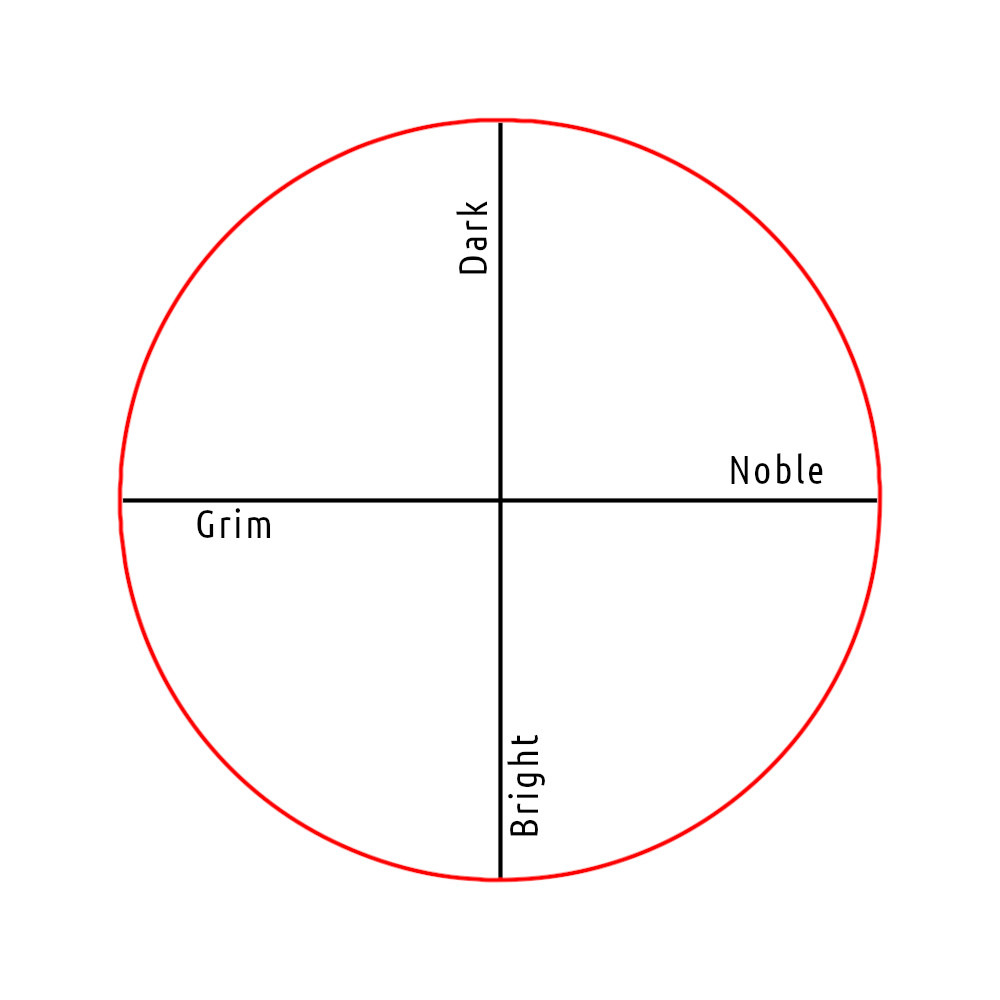
The two axes: Noble and Grim;and Dark and Bright, reflect approaches and general philosophical axioms about the world.
In short, “bright vs. dark axis describes whether the fantasy takes place in a world where good usually triumphs over evil (bright), or a world where evil usually triumphs over good (dark). The noble vs. grim axis describes whether the characters have the power to change the world (noble), or whether they do not (grim). (Vasicek, 2022)”
I want to have a world where evil won, or at least succeeded a while ago, but the party rises to become heroes and face the forces of evil. According to Vasicek (2022), this would be a nobledark kind of setting. Nice! We’re being vague right now but it is important to set a tone.
There is also the kind of level of seriousness expected in this nascent campaign. A light campaign might be more comedic in tone, leading to impromptu characters like Jim Exposition, the friendly know-it-all. Conversely a serious campaign is to be treated with an air of gravity with players treating it like a stage production. I for one, like to strike a balance between all out silly and serious.
Inspiration
“Good artists copy; great artists steal”- Pablo Picasso
This quote discusses how we innovated and expanded upon existing ideas and appropriate them for our own uses (stealing) instead of merely mimicking existing styles. Many people struggle with originality and authenticity during creative endeavors and fear that what they create is merely just imitating what has been done before. I say we lean into that but try to expand, inspiration can come from history, movies, games, current events, songs, and myriad other sources. The originality is how we implement and remix them into our own. Apologies for this tangent but perhaps I feel the need to explain what I mean by campaign inspiration and how crucial this mindset is to creating a campaign setting (or any work for that matter).
Finally we are going to choose elements we want to develop, I usually like going off of inspirations and aping off of those elements. I want to have the pulpy adventure we see in things like Conan the Barbarian, or Indiana Jones– larger than life, death defying heroes getting into fights, overcoming challenges. I also want to include some aspects of political maneuvering and skullduggery like we see in A Song of Ice and Fire series. The Fallout TV series has also been on my radar with the release of its second season and I love it’s approach to a post-apocalyptic world and how people interpret the pre-war world. Though the genre is science fiction, we can borrow those elements for our own setting. Finally, I have fallen in love with the Elric of Melnibone series by Michael Moorcock of late. We have an anti-hero, fallen empires, destiny, demonic blades, weird sorcery; it’s like a nerd’s dream novel, and it was written in 1961!
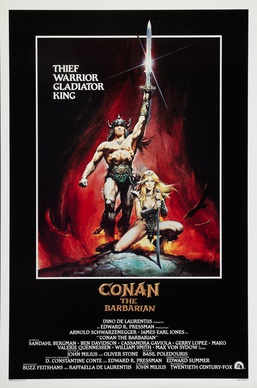
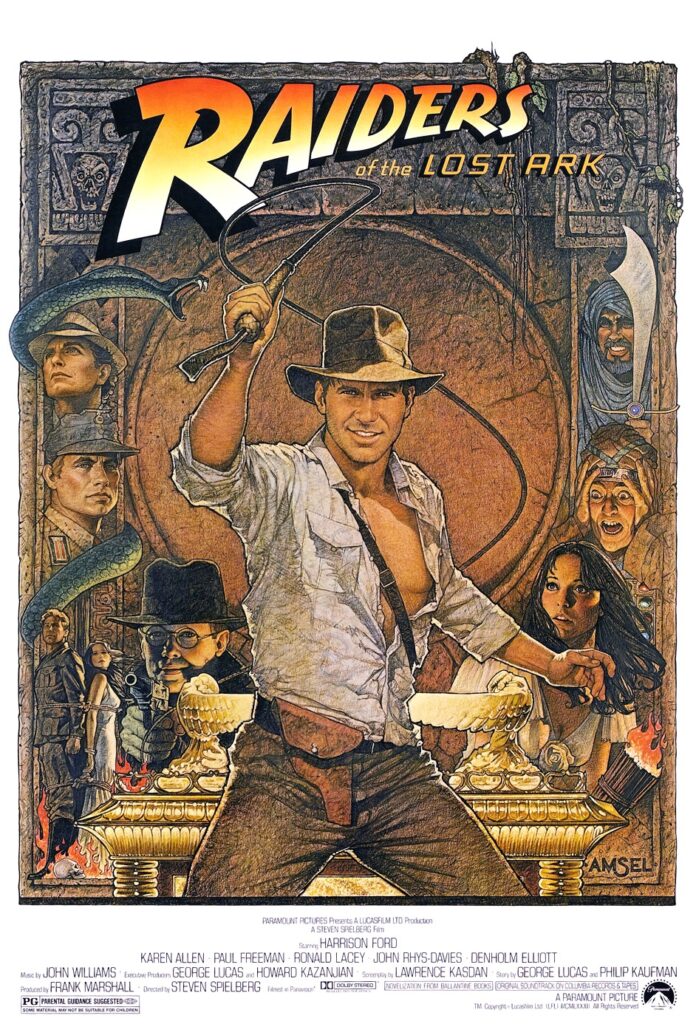

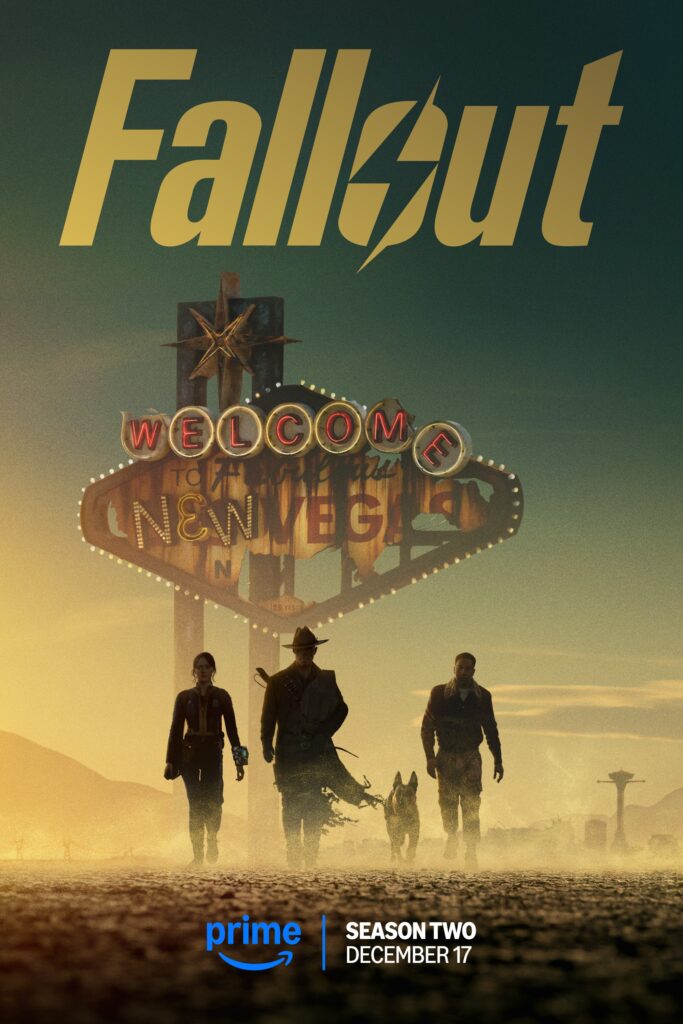
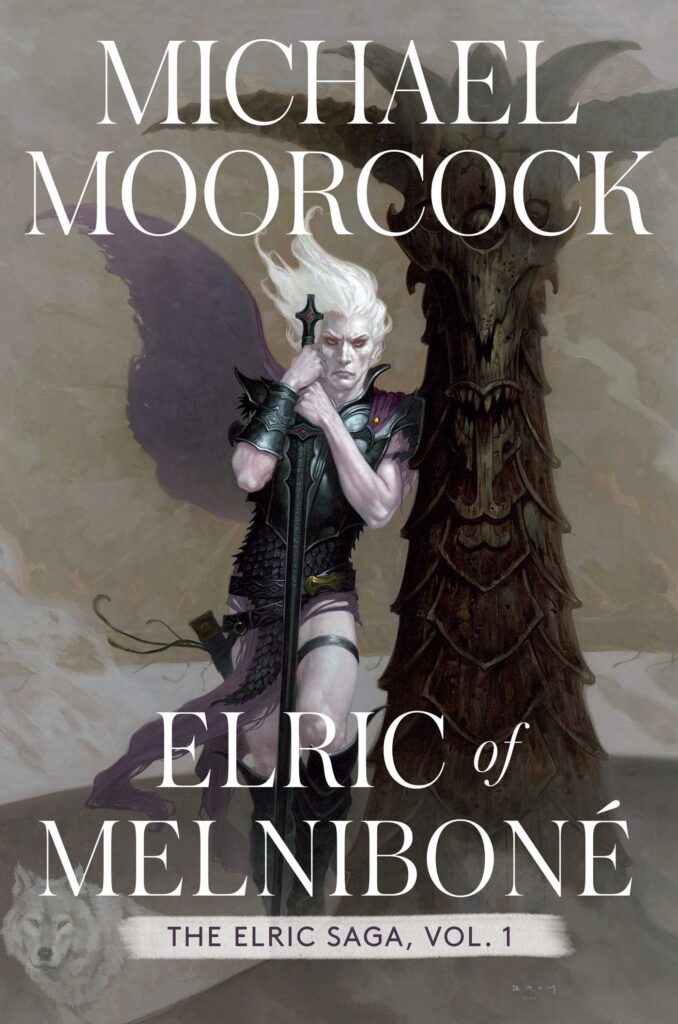
I want to incorporate these themes and elements as we create the fine details of the campaign and the world.
Conclusion
So to recap, we want to make a Noblebright, semi-serious with lots of player freedom and a balanced gameplay approach. We have the inspirations in mind as we start getting pen to paper and fleshing out the locations and events that have shaped this world.
Join me for the next post as I start outlining the details of the setting itself.
References
Benioff, D., & Weiss, D. B.. (2011). Game of Thrones: Season 1. HBO Entertainment; Warner Bros. Home Entertainment.
Milius, J. (Director). (1982). Conan the Barbarian [Film]. Universal Pictures.
Moorcock, M. (2022). Elric of Melniboné: The Elric saga part 1. Saga Press.
Robertson-Dworet, G., & Wagner, G. (2025–2026). Fallout: Season 2. Amazon MGM Studios; Kilter Films; Bethesda Game Studios.
Spielberg, S. (Director). (1981). Raiders of the Lost Ark. Lucasfilm; Paramount Pictures.
Vasicek, J. (2022, June 14). The secular cycle of grimdark vs. noblebright. One Thousand and One Parsecs. https://www.onelowerlight.com/writing/the-secular-cycle-of-grimdark-vs-noblebright/
The audio didn’t record right- I think it was something to do with my mic set-up.
- Reflections on whether you think including H5P tools would potentially be a useful tool at the grade level you hope to teach (or not).
- This week we examined the H5P tools and the interactive videos for use in Pedagogy. Please see my Bloons Tower Defense 5 Ultimate Guide to get a sense of what I’m talking about. (apologies my audio didn’t record right)
- I think the H5P tools would be useful for formative assessment in my area of Social studies. The interactive components can give me real-time check-ins with the students, and check their understanding of a required video, a recorded lecture, or whatever else is used. H5P is just another one of those supplemental tools and should not (like all technology) be used to replace effective instruction.
- Describe how you could use video or audio editing as the assignment medium for the subject and grade level you will be teaching (if at all), and what you could do to make the assignment as engaging as possible.
- Students could create a podcast to describe a historical event for grade 9 Social Studies. In this assignment they are discussing the 1864 Quebec Conference, and the different view points that surrounded the question of Canadian Confederation. The students could take polls from the listeners as well as have little questions for the listeners to check their understanding.
- Describe how Multi-media Learning Theory can help us create more effective instructional videos and tutorials.
- This tool fits in with the Multimedia Learning Theory in which multiple means of engagement are used to present information. The basis for this theory ties into the dual coding theory in which information in the brain is more effectively encoded and accessed when presented in multiple ways such as providing a picture as well as a verbal explanation. That being said there is a point of diminishing returns as providing too much information at once can cause sensory overload.
- This theory reminds us as educators to not just rely on voice or slides but look at many other means of presenting our lesson material. While this does add a level of multi-modality to the lesson, I think it would require some practice to implement effectively. Being sure to not over-stimulate the students and effectively chunk information like narration, visuals, graphs, etc. would take some getting used to.
- Describe what a flipped Flipped Classroom teaching model could look like at the grade level you’d like to teach along with some of the strengths and weaknesses of this approach for your grade level.
- The Flipped classroom teaching model is an approach in which students become the teacher in a way. This student-led approach has the class prepare before class and perform different activities. This approach would be great for Social Studies and a chance to prepare for an inquiry style unit. For example, in grade 9 Social Studies, a major theme is Revolutions of the 18th and 19th centuries. Students would each choose a revolution and teach the class about their revolution. This would give students the freedom to choose what they want; also, this is an opportunity to give the students responsibility and autonomy in how they approach learning. The problem might be in preparation or buy-in if the topic is not interesting to them. Furthermore, some students might be too nervous to present or lack the maturity to take on this responsibility. Another challenge is providing information with enough depth to the standards of the class.
For my EDCI 336 Technology Innovation in Education class, we were tasked with creating, implementing, and documenting a personal learning plan using the open inquiry model of learning.
I want to document my worldbuilding and campaign prep for running tabletop role-playing games.
Worldbuilding is a process where one creates a fictional space detailing and designing things such as creatures, history, geography and so on. This process can make worlds that are very close to real life or as wild and fantastical as the imagination wishes.
Tabletop role-playing games are collaborative storytelling games using dice and rules. Often times there is one player designated as a game master, who acts as the referee, arbitrator, storyteller, all the non-player characters, etc. These games include things like Dungeons and Dragons, Vampire the Masquerade, Call of Cthulhu and many others. These games are divided into sessions (each time the group meets). A collection of sessions with the same group in the same game telling a serial story is called a campaign. Some campaigns can be as short as a single session or be decades-long epics. Check out this video for a summary on tabletop role-playing.
I’d like to try to get back into this hobby and design a new setting for a future campaign. Part of the inquiry will be outlining the steps I am taking, the tools I am using and the sources of inspiration I am drawing from.
Follow along as I document my process as I create a new world full of peril and adventure!
- This week, we examined inquiry and project-based pedagogy as shown in the 2015 documentary Most Likely to Succeed. The documentary examines High Tech High, a school that gives students freedom and flexibility to pursue a project in whatever subject interests them. Students then showcase their projects at a community day, like a science fair, instead of a traditional test or other kind of assessment. This model adjusts goals and outcomes according to the learns own needs and interests, and has the instructors acting more in a supportive and guidance role instead of the more traditional role.
- Do we need to reimagine education?
- I believe we need to reimagine education as the current model of education is based on an outdated model designed for a world that is slowly no longer existing. Schools (and society at large) need to shift their value to planning, teamwork, problem solving and other soft skills as automation and AI are making rote memorization and knowing facts obsolete. I found a helpful video that discusses the importance of soft-skills
- Currently, educators are trying to adjust their strategies to this changing world and how the curriculum is matching up to the challenges that students will face in the real world.
- Changing to a project or inquiry based model as shown in the Most Likely to Succeed might be a way to approach the changing of the times. As it can teach skills like planning, scheduling and teamwork.
- What obstacles do educators face when they try to change pedagogy?
- Assessment might be challenging if only a handful of the institutions recognize the change in pedagogy such as a project or inquiry based learning model. Especially in places that put value on standardized testing like the SAT or provincial exams.
- Another obstacle I can see is that of resources and feasibility- students and schools might not have the time, money or logistical capability to manage a semester long project.
- Lastly, student effort and motivation are factors to consider. Not all students will find value in project based models, or they may not have the skills, confidence, motivation to pursue a project model. This is where scaffolding and teacher guidance will still matter in these kinds of systems of pedagogy
- What concerns you and/or excites you about this approach?
- I am concerned about how the curriculum addresses challenges that students will face in the real world. The world of today is so much different than the world of ten years ago. Addressing the current state of education and performing a paradigm shift to a new system needs to be reactive and reflexive to the state of the world and how the
- Part of what excites me in this approach of project based learning is inspiring students to pursue areas they are passionate in and provide that guidance and support. As seen in the film, one group was not able to make it to the presentation day. While this might seem like a failure on their part, I think of it more as a learning opportunity- “why did this group not succeed?” As a teacher, one should share in their students successes and failures.
Hello everyone!
This is my EDCI 336 blog.
I’m looking forward to sharing my thoughts with you throughout the term.